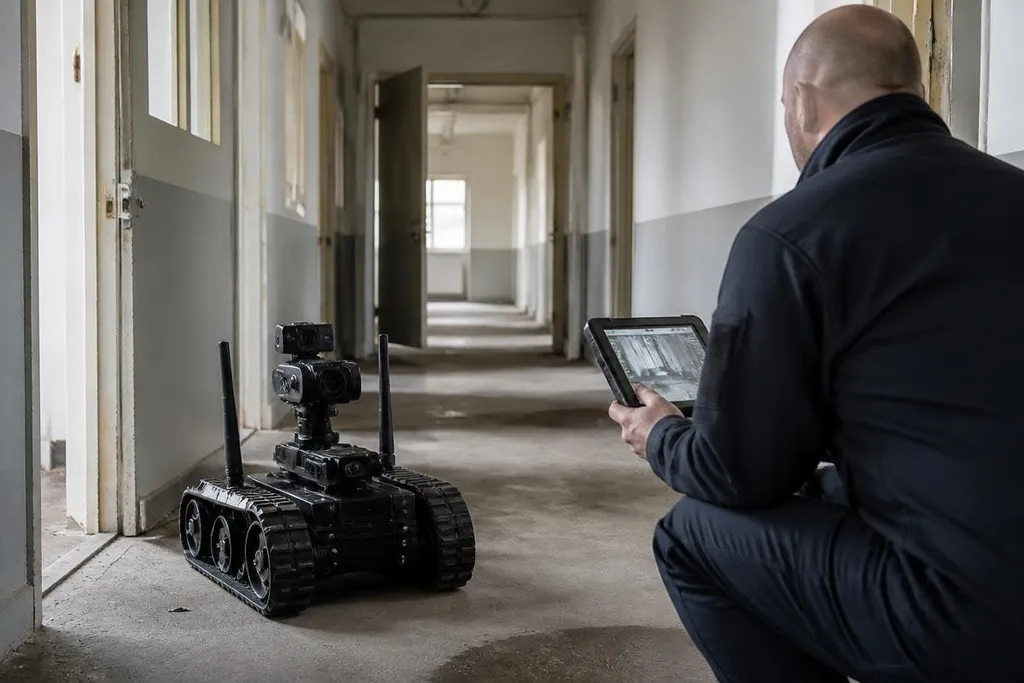
A police robot can now sort video, detect movement, map a building, and flag sounds before an officer reviews the scene. That can reduce the amount of raw sensor data a human must check, but it also creates new ways for software to make a mistake. The useful question is where AI helps, and where its decision must stop.
- Faster review of video and sensor data
- Better maps for buildings and hazardous areas
- Human approval still needed for high-impact actions
Where AI fits inside a police robot
Most police robots use cameras, microphones, wheels or tracks, and a link to a remote operator. AI adds software that can sort what those sensors collect, mark objects in a video feed, or help the robot build a map while it moves.
That changes the operator’s task. Instead of watching every frame from a camera, they can review alerts and choose where the robot should look next. The robot may also keep its position when walls or smoke block a clear view, if its sensors still provide enough data.
These systems do not “understand” a scene in the way a person does. They match sensor input to patterns in their software. A dark coat, a hanging cable, or a reflection can produce a wrong label, especially when the scene differs from the data used to train the system.
What improves in the field
AI can help a robot inspect a dangerous area before people enter it. A machine carrying a camera can move through a damaged building, send back images, and mark doors or blocked routes for the operator. A robot with thermal sensors can point out heat sources that a normal camera may miss.
The benefit comes from reducing search time and distance, not from giving the robot full authority. The operator still needs to decide what an alert means, if the machine should move closer, and when the inspection should stop.
Audio tools can sort speech, alarms, breaking glass, or other sounds for review. That may help when several feeds arrive at once, but sound labels depend on distance, echoes, background noise, and the quality of the microphone. A label is a prompt to check, not proof that an event occurred.
An audio label still leaves an officer deciding what the robot should do next. Reports on police robotics systems from Robot24.com can tie that decision to the sensor, test setting, and operator input, giving departments a better way to judge where the system stops working.
The limits police departments need to test
The first limit is data.
A system trained on clear images may work poorly at night, in rain, through smoke, or in a crowded room. A model that flags objects correctly in one building may produce different results in another building with different walls, lighting, and floor plans.
The second limit is control. A robot can suggest a route, but the department must set rules for movement, recording, remote access, and shutdown. Those rules matter when the machine enters a private space or records people who are not part of the incident.
The third limit is accountability. Police departments need logs that show what the sensors saw, what the software marked, what the operator did, and which action followed. Without that record, it becomes hard to check a disputed alert or explain why the robot moved.
I’d be cautious about any system described as autonomous unless the maker states exactly which tasks it performs without approval. “Autonomous” can mean the robot keeps its position for a few seconds, or it can mean the machine chooses a route and acts on a detection. Those are very different levels of control.
A practical buying and policy checklist
Before a department adds AI to a police robot, it should:
- Define the task in plain words, such as mapping a damaged building or checking a suspicious package.
- Test the system in daylight, darkness, smoke, rain, narrow rooms, and crowded spaces where those conditions apply.
- Set a human approval point before movement, recording, identification, or any other high-impact action.
- Keep time-stamped logs for sensor input, software alerts, operator commands, and robot movement.
- Set retention rules for video, audio, maps, and personal data before the first deployment.
The next useful proof will come from documented field tests that report false alerts, missed detections, operator workload, and shutdown performance across real conditions. Until departments publish those results, AI can help police robots collect and sort information, but a person still needs to decide what that information means.